

Fibrillary Astrocytoma Prognosis: Survival, IDH Status and Treatment
Fibrillary astrocytoma is the classic form of diffuse astrocytoma, a WHO grade 2 brain tumor. Its prognosis depends, above all, on IDH mutation status. Patients with IDH-mutant tumors often live 10 years or more after diagnosis. IDH-wildtype tumors, in contrast, behave like higher-grade disease. This guide explains what the term means today and what the survival data show. It also covers which treatments extend life.
Request a Consultation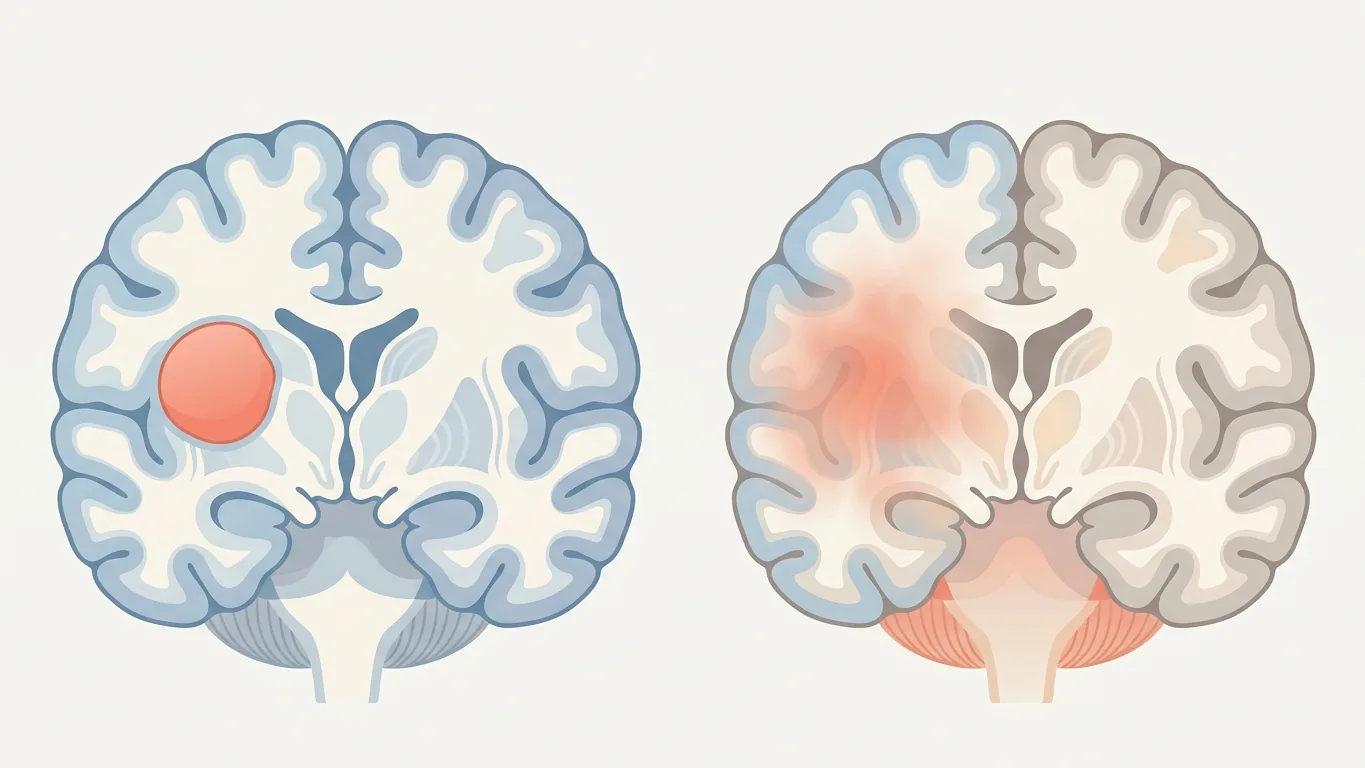
At a Glance
Terminology note: "Fibrillary astrocytoma" comes from older WHO classifications. Since 2021, pathologists classify most of these tumors as "astrocytoma, IDH-mutant, CNS WHO grade 2." If your report uses the older name, ask your team for the IDH result. That result defines the prognosis.
What Is a Fibrillary Astrocytoma?
A fibrillary astrocytoma is a slow-growing, infiltrating brain tumor. It consists of astrocytes with fine, fiber-like processes. Under the microscope, it shows mildly abnormal nuclei. However, it shows no cell division, no dead tissue, and no abnormal blood vessel growth. Those absent features, specifically, separate it from grade 3 and grade 4 astrocytomas.
Pilocytic astrocytoma grows as a compact mass. A fibrillary astrocytoma, in contrast, spreads between normal brain cells. This infiltrative growth means surgeons cannot remove every tumor cell, so some always remain. Consequently, the tumor tends to return and, over years, to become more aggressive.
How the WHO 2021 Classification Changed the Name
Older WHO classifications divided grade 2 diffuse astrocytoma into three variants: fibrillary, gemistocytic, and protoplasmic. Fibrillary was, in fact, by far the most common. The 2016 and 2021 classifications then replaced this histology-based system with a molecular one.
Today, pathologists call a grade 2 diffuse astrocytoma with an IDH1 or IDH2 mutation "astrocytoma, IDH-mutant, grade 2." A diffuse astrocytoma without an IDH mutation falls into a different category. Some of these tumors carry TERT promoter mutation, EGFR amplification, or chromosome 7 gain with chromosome 10 loss. Pathologists now call those glioblastoma, IDH-wildtype. This applies regardless of how quiet they look under the microscope. Our explainer on WHO grades and classification covers this system in full.
Symptoms and Typical Presentation
Fibrillary astrocytoma most often affects adults between 30 and 45 years of age, although any age is possible. Seizures are the first symptom in 60 to 80 percent of patients. Often, the person has no prior neurological history. Because the tumor grows slowly, the seizure may, in fact, remain the only sign for years.
Other symptoms depend on location. They include headache, subtle personality change, word-finding difficulty, or weakness on one side. On MRI, the tumor generally appears as a non-enhancing area in the frontal or temporal lobe. Consequently, an unexplained first seizure in an adult always warrants an MRI.
Fibrillary Astrocytoma Prognosis: The Key Numbers
Older studies grouped all fibrillary astrocytomas together. They reported median survival of about 6 to 8 years. One large registry analysis found survival of 74 percent at 1 year and 55 percent at 3 years. At 5 years it was 49 percent, and at 10 years 38 percent. However, those cohorts mixed IDH-mutant and IDH-wildtype tumors, which follow very different courses.
When researchers separate the groups, however, the picture changes. IDH-mutant grade 2 astrocytomas show median survival of roughly 10 to 15 years in modern series. Many patients live considerably longer. IDH-wildtype tumors with glioblastoma-like molecular features show median survival closer to two years. That figure resembles glioblastoma itself.
| Group | Typical Median Survival | Comment |
|---|---|---|
| All fibrillary astrocytomas, older data | 6 to 8 years | Mixed molecular groups |
| IDH-mutant, grade 2 | 10 to 15 years or more | Improves further with early resection and modern therapy |
| IDH-wildtype with glioblastoma features | About 1 to 2 years | Now classified and treated as glioblastoma |
IDH Status: The Factor That Matters Most
IDH mutation status is, by far, the strongest prognostic factor in fibrillary astrocytoma. An IDH mutation indicates a tumor that grows slowly and responds better to treatment. It also takes longer to transform. As a result, guidelines require IDH testing on every diffuse glioma before treatment planning.
Beyond IDH, pathologists also check for CDKN2A/B deletion. Loss of this gene in an IDH-mutant astrocytoma raises the grade to 4 under the 2021 system. This holds even without microscopic signs of aggression. Therefore, molecular testing does not just refine the prognosis; it defines the diagnosis.
Other Prognostic Factors
Several clinical factors also shape the prognosis alongside IDH status. Doctors then combine them into risk categories that guide treatment timing.
- Age: Patients under 40 fare better than older patients.
- Tumor size: Tumors larger than 5 to 6 centimeters carry more risk.
- Crossing the midline: Tumors that extend into both hemispheres are harder to control.
- Neurological deficit at diagnosis: Weakness or speech problems before treatment predict a harder course.
- Extent of resection: More complete surgery links with longer survival and later transformation.
- Histological variant: The gemistocytic variant behaves more aggressively than the fibrillary variant.
Doctors consider patients over 40, or those with an incomplete resection, high risk. These patients generally receive treatment soon after surgery. Younger patients with a complete resection, in contrast, often start with monitoring.
Malignant Transformation Over Time
Unfortunately, a fibrillary astrocytoma rarely stays grade 2 forever. Over years, genetic changes accumulate. Then the tumor can progress to grade 3 anaplastic astrocytoma or grade 4 glioblastoma. This transformation is, indeed, the main reason the tumor eventually threatens life.
The timing, however, varies widely. Some tumors transform within a few years; others remain stable for more than a decade. Extent of resection, IDH status, and treatment all influence the interval. Our articles on anaplastic astrocytoma and the difference between IDH-mutant and IDH-wildtype glioblastoma describe what happens next.
Surgery: Early Resection vs Watchful Waiting
Early, extensive surgery clearly improves survival in fibrillary astrocytoma. For example, a Norwegian study compared two hospitals with different philosophies. The hospital that favored early resection achieved median survival of 14.4 years. The hospital that favored biopsy and watchful waiting, however, achieved 5.8 years. Consequently, most guidelines now recommend maximal safe resection as soon as the diagnosis is likely.
The tumor infiltrates normal brain. Therefore, surgeons use awake mapping, neuronavigation, and intraoperative imaging. These tools remove as much tumor as possible while protecting function. Our article on awake craniotomy explains how mapping protects speech and movement during resection.
Radiation and Chemotherapy
After surgery, high-risk patients generally receive radiation followed by chemotherapy. The landmark RTOG 9802 trial tested PCV chemotherapy (procarbazine, lomustine, and vincristine) after radiation in high-risk grade 2 glioma. Adding PCV extended median survival from 7.8 years to 13.3 years. This result, consequently, changed practice worldwide.
Temozolomide is an oral alternative; many centers use it because patients tolerate it more easily. Doctors time radiation carefully. It carries long-term cognitive risks in patients who may live for decades. Therefore, low-risk patients often defer radiation until the tumor shows growth.
Vorasidenib: A New Option for IDH-Mutant Grade 2 Tumors
Vorasidenib is the first targeted drug for IDH-mutant grade 2 glioma, specifically. It blocks the mutant IDH1 and IDH2 enzymes that drive tumor growth. In the phase 3 INDIGO trial, vorasidenib extended progression-free survival from 11.1 months to 27.7 months. The comparison group received placebo. It also delayed the need for radiation or chemotherapy.
The FDA approved vorasidenib in August 2024. It covers patients with IDH-mutant grade 2 astrocytoma or oligodendroglioma after surgery. Consequently, many younger patients can now postpone radiation for years while taking a daily tablet. Long-term survival data are still maturing. Nevertheless, the early results mark a genuine shift in treatment.
Compared With Other Astrocytoma Grades
Fibrillary astrocytoma sits, overall, in the middle of the astrocytoma spectrum. The table shows how it compares with the grades above and below it.
| Tumor | WHO Grade | Growth Pattern | Typical Median Survival |
|---|---|---|---|
| Pilocytic astrocytoma | 1 | Compact, non-infiltrating | Normal lifespan after complete removal |
| Fibrillary (diffuse) astrocytoma, IDH-mutant | 2 | Infiltrating, slow | 10 to 15 years or more |
| Anaplastic astrocytoma, IDH-mutant | 3 | Infiltrating, faster | 6 to 10 years |
| Glioblastoma, IDH-wildtype | 4 | Rapid, invasive | About 15 to 18 months |
For each of the neighboring grades, see our guides to pilocytic astrocytoma survival, the anaplastic astrocytoma survival rate, and the glioblastoma survival rate.
Living With a Grade 2 Astrocytoma
Generally, patients with an IDH-mutant fibrillary astrocytoma live active lives for many years. Seizure control is often the main daily concern. Fortunately, modern anti-seizure medication manages it well in most cases. Regular MRI tracks the tumor. Typically, scans occur every three to six months at first and then every six to twelve months.
Work, family life, and travel generally continue as well. Nevertheless, patients benefit from a clear plan for what happens if the tumor grows. Then nobody has to decide in a crisis. A second opinion at diagnosis often helps families understand the full range of options.
Expert Insight: Prof. Dr. Serdar Baki Albayrak
Surgery Sets the Clock
Prof. Dr. Serdar Baki Albayrak has operated on diffuse gliomas of every grade for more than 27 years. For grade 2 astrocytoma, he favors early, mapping-guided resection. The evidence shows that extent of resection lengthens survival and delays transformation.
"A grade 2 astrocytoma gives us time, but only if we use it. An early, thorough resection with the patient's function protected is the best investment a patient can make in the years ahead."
Prof. Dr. Serdar Baki Albayrak
Discuss Your Prognosis and Surgical Options
We review MRI, pathology, and molecular results. Then we explain what your IDH status means and whether early resection suits you.
Schedule a ConsultationFrequently Asked Questions
What is the prognosis for fibrillary astrocytoma?
It depends on IDH status. IDH-mutant grade 2 astrocytomas carry a median survival of roughly 10 to 15 years or more. Older mixed cohorts reported 6 to 8 years. IDH-wildtype tumors with glioblastoma features behave like glioblastoma.
Is fibrillary astrocytoma cancer?
Yes, it is a malignant glioma, although a low-grade one. It infiltrates the brain and can transform into a higher grade over time. Doctors treat it seriously; nevertheless, many patients live well for a decade or longer.
Is fibrillary astrocytoma the same as diffuse astrocytoma?
Fibrillary astrocytoma was the most common subtype of grade 2 diffuse astrocytoma in older classifications. Since 2021, pathologists use molecular labels instead, most often "astrocytoma, IDH-mutant, grade 2." Both terms describe largely the same tumor.
Does surgery cure a fibrillary astrocytoma?
Surgery rarely removes every cell, because the tumor infiltrates normal brain. However, early and extensive resection roughly doubled median survival in a well-known comparative study. Surgery therefore remains the most important single treatment.
What is vorasidenib and who can take it?
Vorasidenib is an oral IDH inhibitor. The FDA approved it in 2024 for IDH-mutant grade 2 astrocytoma and oligodendroglioma after surgery. In the INDIGO trial, it more than doubled progression-free survival. It also delayed the need for radiation or chemotherapy.
How often does fibrillary astrocytoma turn into glioblastoma?
Most grade 2 astrocytomas eventually progress to a higher grade. However, the timing ranges from a few years to well over a decade. Early complete resection, IDH mutation, and modern therapy all lengthen the interval.
Can you live a normal life with a grade 2 astrocytoma?
Many patients do, in fact, for years. Seizure control, regular MRI, and a clear plan for future growth make this possible. Most people continue working, traveling, and raising families. Ongoing monitoring, however, is the price of that normality.
A Prognosis Defined by Biology and Surgery
The prognosis for fibrillary astrocytoma depends on two things above all. These are the tumor's IDH status and the extent of the first resection. IDH-mutant tumors treated with early, thorough surgery and modern therapy now offer a median survival well beyond a decade. Vorasidenib and refined radiation and chemotherapy sequencing continue to push that figure upward.
Therefore, patients should insist on molecular testing. They should also seek a surgeon experienced in mapping-guided glioma resection. Learn about our approach to glioma surgery in Istanbul. Also, explore our overview of treatment approaches for every grade.
Talk to Our Team About Your Outlook
We provide honest, evidence-based guidance. It rests on your specific molecular results and imaging.
Contact Us TodayDisclaimer: This page is provided for informational purposes only and does not constitute medical advice. Statistics represent published group averages and cannot predict any individual outcome. Always consult Prof. Dr. Serdar Baki Albayrak or another qualified physician directly regarding any medical condition, symptoms, or treatment decisions.
Discuss Your Case With Our Team
Send your MRI report and pathology details for a structured, honest opinion from an experienced brain tumor surgeon in Istanbul.
Request a Consultation