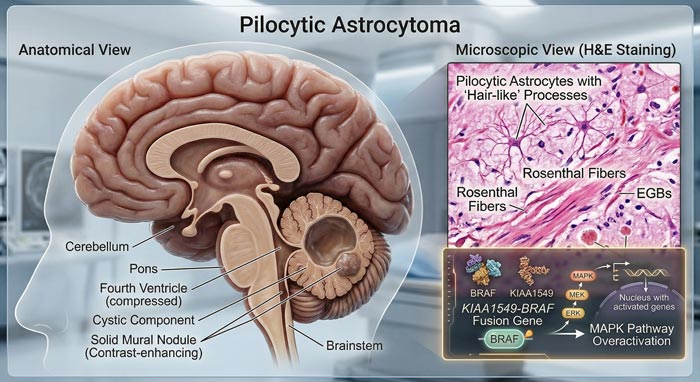

Pilocytic astrocytoma has one of the highest survival rates of any brain tumor. Published studies report a 5-year survival rate of roughly 95 to 97 percent. Moreover, most patients who reach the 10-year mark go on to live a normal lifespan.
This article breaks those numbers down by age, tumor location, and extent of surgery. As a result, you can see where an individual case fits.
A note on statistics: Every figure below comes from published group data. Therefore, it describes averages across many patients, not a prediction for one person. Two people with the same diagnosis can have different outcomes. Tumor location, age, and the extent of safe removal explain the difference.
In This Article
- Pilocytic Astrocytoma Survival Rate at a Glance
- What Is the Life Expectancy After Diagnosis?
- Survival in Children and Juvenile Pilocytic Astrocytoma
- Survival in Adults
- Why Extent of Resection Matters Most
- Survival by Tumor Location
- Can a Pilocytic Astrocytoma Grow Back?
- Does It Ever Turn Malignant?
- Other Factors That Shape Prognosis
- Overall Survival vs Progression-Free Survival
- How Patients Can Protect Their Prognosis
- Compared With Other Astrocytoma Grades
- Long-Term Follow-Up After Treatment
- Expert Insight: Prof. Dr. Serdar Baki Albayrak
- Frequently Asked Questions
Pilocytic Astrocytoma Survival Rate at a Glance
The pilocytic astrocytoma survival rate stays excellent at every time point that researchers have measured. Because the tumor is WHO grade 1, it grows slowly and rarely spreads. Consequently, surgery alone cures most patients.
| Time After Diagnosis | Overall Survival | Main Source |
|---|---|---|
| 5 years | 95 to 97 percent (all ages) | Population registries, institutional series |
| 10 years | 92 to 96 percent | Swiss population study, Cleveland Clinic summary |
| 20 years | Approximately 90 percent in pediatric series | Long-term pediatric cohorts |
| 5 years, adults only | About 87 percent | 2025 multicenter adult cohort (90 patients) |
In other words, more than nine out of ten patients are alive a decade after diagnosis. Furthermore, the few deaths in these studies often relate to tumor location or treatment complications. Tumor growth itself is rarely the cause.
What Is the Life Expectancy After Diagnosis?
Life expectancy after complete removal of a pilocytic astrocytoma comes close to that of the general population. Long-term studies follow patients for 20 to 30 years. Most of them live without any tumor-related limitation. Therefore, doctors often describe this tumor as curable rather than merely treatable.
However, life expectancy does depend on a few conditions. First, the surgeon must remove the tumor completely, or nearly so. Second, the tumor must sit in a location that allows safe surgery. Third, the patient must avoid serious complications such as untreated hydrocephalus.
When these conditions are met, survival curves flatten after the first few years. After that, they stay flat.
For patients with a residual tumor, life expectancy remains high, but the follow-up period is longer. Residual pilocytic astrocytoma often stays stable for decades. In fact, some residual tumors shrink on their own without any treatment.
Survival in Children and Juvenile Pilocytic Astrocytoma
Juvenile pilocytic astrocytoma is the most common brain tumor in children. It also carries the best prognosis. Roughly 75 percent of all cases appear before age 20. In pediatric series, 5-year survival reaches 95 to 100 percent, and 10-year survival stays above 95 percent.
Children with tumors in the cerebellum do especially well. Surgeons achieve complete removal in most cerebellar cases, and recurrence after complete removal is rare. By contrast, tumors of the optic pathway and hypothalamus are harder to remove. Even so, these children usually survive long term, although they need closer monitoring.
The one exception is infancy. Children diagnosed under one year of age have the least favorable outcomes in the pilocytic group. This partly reflects a higher share of the pilomyxoid variant in that age group. That variant behaves more aggressively.
Survival in Adults
Adults account for only about 5 percent of pilocytic astrocytoma cases. Their outcomes are slightly less favorable than those of children. A 2025 multicenter study followed 90 surgically treated adults. It reported 5-year overall survival of 86.6 percent and 5-year progression-free survival of 77.1 percent. Similarly, older institutional series report adult recurrence rates near 20 percent. In children, the rate is about 10 percent.
Why the gap? Adult tumors sit less often in the cerebellum and more often in deep or eloquent brain regions. Consequently, surgeons remove them completely less often.
In addition, adult tumors carry BRAF fusions less frequently, which may reflect slightly different biology. Nevertheless, an adult with a completely removed tumor has an outlook very close to a child’s.
Why Extent of Resection Matters Most
Extent of resection predicts pilocytic astrocytoma survival and recurrence more strongly than any other factor. The 2025 adult cohort makes this clear. After gross total removal, only 11 percent of tumors recurred.
Without gross total removal, however, recurrence rose to 45 to 53 percent. Notably, this held true whether or not patients received additional therapy.
| Extent of Surgery | Recurrence Rate | Typical Next Step |
|---|---|---|
| Gross total resection | About 10 percent (adults 11 percent) | MRI surveillance only |
| Subtotal resection, no adjuvant therapy | Up to 53 percent | Close MRI follow-up, treat on growth |
| Subtotal resection, with adjuvant therapy | About 45 percent | Chemotherapy or targeted therapy |
Importantly, recurrence is not the same as death. Most recurrent pilocytic astrocytomas respond to a second surgery, chemotherapy, or targeted drugs, as our treatment guidelines summary explains. Therefore, overall survival stays high even in the subtotal resection group. Our guide to grade 1 pilocytic astrocytoma symptoms and treatment explains the surgical planning. In particular, it covers maximal safe removal.
Survival by Tumor Location
Tumor location shapes survival mainly because it determines the extent of removal. In the adult cohort above, gross total resection succeeded in 88 percent of cerebral hemisphere tumors. Similarly, it succeeded in 76 percent of cerebellar tumors. In deep locations, however, that figure fell to just 14 percent.
- Cerebellum: The most common site and the most favorable. Surgeons generally achieve complete removal, and cure rates exceed 95 percent. See our article on cerebellar pilocytic astrocytoma.
- Cerebral hemispheres: Also very favorable, especially in non-eloquent areas.
- Optic pathway and hypothalamus: Complete removal is rarely possible. Survival remains high, but vision and hormone function need lifelong attention.
- Brainstem: Surgery carries more risk, so surgeons often remove only the exophytic part. Long-term survival is still common.
- Spinal cord: Rare, with outcomes that depend on preoperative function.
Can a Pilocytic Astrocytoma Grow Back?
Yes, a pilocytic astrocytoma can grow back. However, it does so mainly when part of the tumor remains after surgery. After complete removal, recurrence is uncommon, with rates near 10 percent or lower in most series. After partial removal, regrowth occurs in roughly half of patients over the following years.
Timing matters as well. Most recurrences appear within the first three to five years. Neurosurgeons sometimes use Collins’ law as a guide. Under this rule, the period of risk equals the patient’s age at diagnosis plus nine months. Beyond that window, late recurrence becomes rare, although it is not impossible.
Certain features raise the risk of regrowth. Solid rather than cystic tumors and infiltration into surrounding brain raise the risk. So does pilomyxoid histology. As a result, surgeons schedule closer MRI follow-up for patients with these features.
Does It Ever Turn Malignant?
Malignant transformation of a pilocytic astrocytoma is very rare. Reported rates fall well below 2 percent in most long-term series. When it does happen, it often occurs many years after radiation therapy. This is one reason doctors avoid radiation for this tumor whenever possible.
Because transformation is so uncommon, a pilocytic astrocytoma that regrows usually keeps its original low-grade behavior. Consequently, doctors treat recurrence with the same tools they used at first. Surgery comes first, then chemotherapy or targeted therapy if needed.
Other Factors That Shape Prognosis
Beyond resection and location, several factors influence outcome:
- Age at diagnosis: Infants under one year fare worst; older children and young adults fare best.
- Neurological deficits before surgery: In the 2025 adult study, patients with no deficits before surgery had significantly better progression-free survival.
- Neurofibromatosis type 1 (NF1): Optic pathway tumors in NF1 often stay stable or regress. Doctors avoid radiation in this group because of the risk of second tumors.
- Histological variant: The pilomyxoid variant carries a higher recurrence rate and shorter progression-free survival.
- Molecular profile: KIAA1549-BRAF fusion is common in cerebellar tumors and links with a favorable course. BRAF V600E mutation may carry a somewhat higher progression risk.
Overall Survival vs Progression-Free Survival
Studies report two different survival measures, and patients often confuse them. Overall survival counts patients who are alive at a given time, regardless of tumor status. Progression-free survival counts patients whose tumor has not grown or returned.
For pilocytic astrocytoma, the gap between these two numbers is wide. In the 2025 adult cohort, for example, 5-year overall survival reached 86.6 percent. Meanwhile, 5-year progression-free survival reached 77.1 percent. In other words, some tumors progressed, but most of those patients still survived after further treatment. Therefore, a lower progression-free figure does not mean a lower chance of living a long life.
How Patients Can Protect Their Prognosis
Patients and families influence the outcome more than they often realize. Above all, the choice of surgical team matters. A complete first resection drives every survival figure in this article. Consequently, we encourage families to ask surgeons about their expected extent of resection before the operation.
- Seek an experienced brain tumor surgeon and ask about neuronavigation, intraoperative monitoring, and ultrasound.
- Keep every follow-up MRI, even years after surgery, because early detection of regrowth keeps treatment simple.
- Request molecular testing for BRAF status. It opens the door to targeted therapy if the tumor ever returns.
- Consider a second opinion before radiation, which doctors reserve for tumors that keep growing despite other options.
Our guide on when to seek a second opinion for a brain tumor explains how to organize imaging and pathology for outside review.
Compared With Other Astrocytoma Grades
The contrast between pilocytic astrocytoma and higher-grade astrocytomas looks striking. Surgery generally cures grade 1 tumors. Grade 2 tumors grow slowly but infiltrate the brain. Grade 3 and 4 tumors require aggressive multimodal treatment.
| Tumor | WHO Grade | Typical 5-Year Survival |
|---|---|---|
| Pilocytic astrocytoma | 1 | 95 to 97 percent |
| Diffuse (fibrillary) astrocytoma, IDH-mutant | 2 | Roughly 50 to 80 percent, depending on treatment era |
| Anaplastic astrocytoma | 3 | About 47 to 72 percent, depending on IDH status |
| Glioblastoma | 4 | About 5 to 7 percent |
For a deeper comparison, see our articles on the anaplastic astrocytoma survival rate and the glioblastoma survival rate. Our explainer on WHO grades and classification describes how pathologists assign each grade.
Long-Term Follow-Up After Treatment
Follow-up MRI protects the excellent survival rate by catching regrowth early. After complete removal, most centers scan at three months. Then, they scan every six to twelve months for several years.
Many guidelines stop routine imaging after roughly three to five years of stability. After partial removal, however, scans continue longer, often for a decade or more.
Our guide to recovery after pilocytic astrocytoma surgery explains what the first weeks and months look like.
Follow-up also covers quality of life. Children need monitoring of growth, hormones, vision, and school performance, especially after hypothalamic or optic pathway tumors. Adults benefit from attention to seizures, balance, and return to work. Consequently, a good long-term result means more than survival alone.
Expert Insight: Prof. Dr. Serdar Baki Albayrak
Survival Starts With the First Operation
Prof. Dr. Serdar Baki Albayrak has treated brain tumors of every grade for more than 27 years. His experience includes pediatric and adult pilocytic astrocytomas. In his experience, the first surgery carries the most weight. A complete, safe first resection converts an excellent statistical prognosis into a personal cure for most patients.
“With pilocytic astrocytoma the numbers are on the patient’s side from day one. My task is to protect those numbers with a careful, complete first operation. A sensible follow-up plan does the rest.”
Prof. Dr. Serdar Baki Albayrak
Discuss Your Individual Prognosis
Every case is different. Our team reviews your imaging, pathology, and surgical history to give you an honest, personalized outlook.
Frequently Asked Questions
What is the survival rate for pilocytic astrocytoma?
Published data show a 5-year survival rate of about 95 to 97 percent. The 10-year survival rate is about 92 to 96 percent. These figures cover all ages and locations combined. Patients with a completely removed tumor do even better than the average.
How long can you live with a pilocytic astrocytoma?
Most patients live a normal lifespan. After complete surgical removal, long-term studies show survival curves that flatten after the first few years. Even with a residual tumor, many people live for decades with only periodic MRI checks.
Is the prognosis for juvenile pilocytic astrocytoma different from adults?
Yes, slightly. Children reach 5-year survival of 95 to 100 percent, while adults reach about 87 percent. Adult tumors sit more often in deep brain regions, so complete removal is harder. An adult with a completely removed tumor, however, has an outlook similar to a child’s.
Can a pilocytic astrocytoma come back after surgery?
It can, mainly when part of the tumor remains. Recurrence after complete removal is around 10 percent or lower. After partial removal, roughly half of tumors regrow over time. Most recurrences still respond well to further treatment.
Does a pilocytic astrocytoma shorten life expectancy without complete removal?
Usually not by much. Residual tumor often stays stable or even shrinks. When it grows, chemotherapy, targeted therapy, or a second surgery controls it in most cases. Life expectancy therefore remains high, although follow-up lasts longer.
Which factors lower the pilocytic astrocytoma survival rate?
Incomplete removal, deep or brainstem location, and diagnosis under one year of age lower the odds. So do pilomyxoid histology and neurological deficits before surgery. Even in these groups, however, most patients survive long term.
What is the 20-year survival rate for pilocytic astrocytoma?
Long-term pediatric cohorts report survival near 90 percent at 20 years. Deaths after the first decade occur rarely, and they often have nothing to do with the original tumor. This is why doctors consider the condition curable for most patients.
Conclusion: A Prognosis Measured in Decades
Pilocytic astrocytoma survival rates are among the best in neuro-oncology. Roughly 95 percent of patients survive five years. Most of them then go on to a normal life expectancy. Complete surgical removal matters most, followed by tumor location and age.
Therefore, the right first operation matters enormously. If you or your child has received this diagnosis, review our complete pilocytic astrocytoma guide. Then, learn how we plan brain tumor surgery in Istanbul for international patients.
Talk to Our Team About Your Outlook
We provide honest, evidence-based guidance. It rests on your specific imaging, pathology, and treatment history.
Last reviewed: September 2026 | Reviewed by: Prof. Dr. Serdar Baki Albayrak, Neurosurgeon
Disclaimer: This article is provided for informational purposes only and does not constitute medical advice. Survival and outcome statistics represent published group averages and cannot predict any individual outcome. This content is not a substitute for professional diagnosis or treatment. Always consult Prof. Dr. Serdar Baki Albayrak or another qualified physician directly regarding any medical condition, symptoms, or treatment decisions.