
Treatment guidelines for pilocytic astrocytoma place surgery first, chemotherapy second, and radiation last. In fact, complete surgical removal cures most patients and requires no further treatment. When surgeons cannot remove the whole tumor, doctors watch the remainder with MRI. They treat it only if it grows. Chemotherapy and, increasingly, BRAF-targeted drugs then control the tumor. As a result, the developing brain avoids radiation.
Guideline basis: This article summarizes the approach shared by pediatric neuro-oncology consortia and adult glioma guidelines. It also reflects recent FDA approvals. However, individual treatment decisions depend on tumor location, age, molecular results, and patient preference. Always discuss your case with a multidisciplinary team.
In This Article
- The Treatment Ladder at a Glance
- Step 1: Maximal Safe Surgical Resection
- Step 2: Observation After Incomplete Resection
- When Do Doctors Treat a Residual Tumor?
- Chemotherapy for Pilocytic Astrocytoma
- BRAF and MEK Targeted Therapy
- Where Radiation Fits
- Treatment Differences in Adults
- Special Case: Neurofibromatosis Type 1
- Managing Hydrocephalus
- Treating Recurrence
- Follow-Up Schedule
- Expert Insight: Prof. Dr. Serdar Baki Albayrak
- Frequently Asked Questions
The Treatment Ladder at a Glance
Doctors treat pilocytic astrocytoma in a stepwise way. Each step comes into play only if the previous one leaves tumor behind that then grows. Consequently, most patients never need anything beyond the first step.
| Step | Treatment | Who Needs It | Goal |
|---|---|---|---|
| 1 | Maximal safe surgery | Nearly all patients | Cure by complete removal |
| 2 | MRI observation | Residual tumor after surgery | Avoid overtreatment of stable tumor |
| 3 | Chemotherapy or targeted therapy | Growing residual or unresectable tumor | Control growth, delay or avoid radiation |
| 4 | Radiation therapy | Tumors that keep growing despite other options | Long-term control when alternatives fail |
Step 1: Maximal Safe Surgical Resection
Surgery is the cornerstone of every pilocytic astrocytoma treatment guideline, so it always comes first. Gross total resection cures the tumor in the large majority of cases. Recurrence rates after it stay near 10 percent or lower. Therefore, surgeons aim for complete removal whenever the tumor’s location allows it.
Several technical points shape the operation. First, surgeons remove the solid, enhancing nodule as the priority. A cyst wall that does not enhance on MRI usually contains no tumor. Therefore, it does not need removal. In addition, neuronavigation, intraoperative ultrasound, and neuromonitoring guide the surgeon. Together, they limit damage to healthy tissue.
In some locations, complete removal would harm vision, hormones, or movement. There, the guideline shifts to maximal safe resection. This means removing as much as possible without causing a new deficit. Our full guide to pilocytic astrocytoma symptoms, treatment, and prognosis explains how location affects surgical planning.
Step 2: Observation After Incomplete Resection
After an incomplete resection, guidelines recommend observation rather than immediate treatment. This surprises many families; however, the evidence supports it. Residual pilocytic astrocytoma frequently stays stable for years. Moreover, a meaningful minority of residuals shrink or disappear on their own.
Observation means regular MRI scans. Typically, they occur every three to four months in the first year and then every six months. Then, if the residual stays stable, the interval lengthens. Consequently, many patients avoid chemotherapy and radiation entirely, even with visible tumor on their scans.
When Do Doctors Treat a Residual Tumor?
Doctors begin active treatment when a residual tumor shows clear growth on serial MRI. New symptoms are the other trigger. Typical triggers include:
- Measurable enlargement of the solid component across two or more scans
- A growing cyst that presses on surrounding brain
- New or worsening vision loss, hormone dysfunction, weakness, or seizures
- Recurrent hydrocephalus caused by the tumor
When treatment becomes necessary, the first question is whether a second surgery can remove the tumor. If it can, surgery remains the preferred option. If not, medical therapy follows next.
Chemotherapy for Pilocytic Astrocytoma
Chemotherapy for pilocytic astrocytoma aims to control growth rather than to cure. In children, it mainly delays or avoids radiation until the brain matures. The most widely used regimen combines carboplatin and vincristine, generally given over roughly a year. Published series report 5-year progression-free survival of about 34 to 45 percent with this combination. In other words, it stabilizes many tumors for years.
Weekly vinblastine offers a well-established alternative. It achieves similar control rates, yet it has a different side-effect profile. Other options include a combination of thioguanine, procarbazine, lomustine, and vincristine, and, in adults, temozolomide. Doctors choose among these based on age, prior treatment, and tolerance, particularly in very young children with the pilomyxoid variant.
| Regimen | Typical Use | Key Points |
|---|---|---|
| Carboplatin + vincristine | First-line in children | About 1 year of treatment; 5-year PFS 34 to 45 percent |
| Weekly vinblastine | First-line alternative or second-line | Outpatient infusion; generally well tolerated |
| Temozolomide | Mainly adults | Oral; response rate about 42 percent in a multicenter adult cohort |
| Dabrafenib + trametinib | BRAF V600E tumors | FDA-approved first-line for pediatric low-grade glioma with this mutation |
| Tovorafenib | BRAF fusion or V600 mutation, after relapse | FDA accelerated approval in 2024; first drug for BRAF fusions |
BRAF and MEK Targeted Therapy
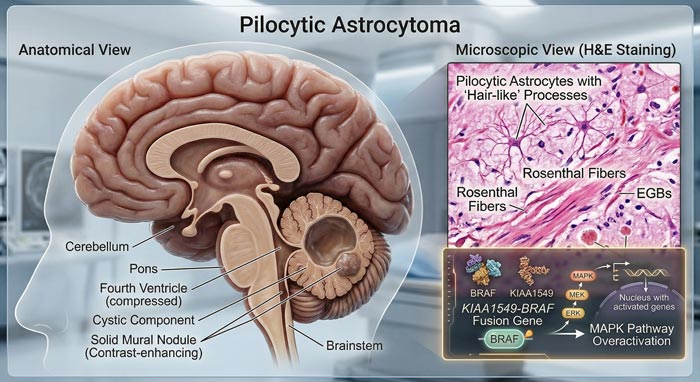
Targeted therapy has changed pilocytic astrocytoma treatment guidelines in the past few years. More than 70 percent of these tumors carry a BRAF alteration, most often the KIAA1549-BRAF fusion. A smaller share carry the BRAF V600E point mutation. Because both drive tumor growth through the MAPK pathway, drugs that block that pathway can shrink the tumor.
Two approvals matter most. In March 2023, the FDA approved dabrafenib plus trametinib for children with BRAF V600E low-grade glioma. It is a first-line option. In the pivotal trial, 47 percent of patients responded. In contrast, only 11 percent responded to carboplatin and vincristine. Then, in April 2024, the FDA granted accelerated approval to tovorafenib. It covers relapsed or refractory pediatric low-grade glioma with a BRAF fusion or V600 mutation. This marked the first approval of a drug for the fusion. Notably, the fusion is the most common alteration in pilocytic astrocytoma.
Therefore, guidelines now recommend molecular testing of every pilocytic astrocytoma that may need medical therapy. MEK inhibitors such as selumetinib remain under study and are available through clinical trials in many countries. Learn more about how to find and join a brain tumor clinical trial.
Where Radiation Fits
Radiation therapy sits at the bottom of the treatment ladder for pilocytic astrocytoma. It controls the tumor effectively. However, it carries long-term risks that matter for a tumor most patients survive for decades. These risks include cognitive decline, hormone deficiency, and vascular injury. In addition, there is a small chance of a second tumor or malignant transformation.
Consequently, guidelines reserve radiation for tumors that keep growing despite surgery, chemotherapy, and targeted therapy. When doctors do use it, they prefer highly focused techniques, such as stereotactic radiosurgery or proton therapy. In children under a certain age, they avoid it whenever any alternative exists.
Treatment Differences in Adults
Adult pilocytic astrocytoma follows the same basic principles, with a few differences. Adults generally tolerate surgery well, and gross total resection remains the goal. However, adult tumors sit more often in deep or eloquent regions, so complete removal succeeds less often.
When adults need medical therapy, doctors most commonly choose temozolomide. A recent multicenter cohort reported an objective response in 42 percent of adults. Median progression-free survival was 20 months. Adults with BRAF alterations can also receive targeted drugs, although the formal approvals cover pediatric patients. Doctors also use radiation somewhat more readily in adults than in children. After all, the developing brain is no longer a concern.
Special Case: Neurofibromatosis Type 1
Patients with neurofibromatosis type 1 (NF1) often develop pilocytic astrocytomas of the optic pathway. Guidelines treat these tumors conservatively. Many never grow; therefore, doctors monitor them with MRI and eye examinations rather than operating.
When an NF1-associated tumor threatens vision, doctors usually start chemotherapy first, often carboplatin and vincristine. Doctors avoid radiation in NF1 because it raises the risk of second tumors and vascular problems. In addition, MEK inhibitors have shown encouraging results in this group in clinical trials.
Managing Hydrocephalus
Hydrocephalus accompanies many pilocytic astrocytomas, especially those in the cerebellum. Therefore, treatment guidelines address it directly. Generally, removing the tumor relieves the blockage. Nevertheless, some patients need a temporary drain before surgery and a minority need a permanent solution afterward.
Options include an external ventricular drain for short-term control, endoscopic third ventriculostomy, or a ventriculoperitoneal shunt. Our article on recovery after pilocytic astrocytoma surgery describes how hydrocephalus management affects the hospital stay.
Treating Recurrence
Recurrent pilocytic astrocytoma also remains highly treatable. Because the tumor rarely changes its grade, doctors reuse the same ladder. Surgery comes first if feasible, then targeted therapy or chemotherapy, then radiation if all else fails. Molecular testing of the recurrent tissue then guides the choice of drug.
Encouragingly, survival after recurrence stays high. Our article on pilocytic astrocytoma survival rate and life expectancy explains this point. In short, progression rarely shortens life.
Follow-Up Schedule
Follow-up after treatment depends mainly on how much tumor remains. The schedule below reflects common practice at major centers, although individual protocols vary.
| Situation | Year 1 | Years 2 to 5 | After Year 5 |
|---|---|---|---|
| Complete resection | MRI at 3 and 12 months | MRI every 12 months | Often stop routine MRI if stable |
| Residual tumor, stable | MRI every 3 to 4 months | MRI every 6 months | MRI every 12 months long term |
| On chemotherapy or targeted therapy | MRI every 3 months | Per protocol | Per protocol |
Follow-up also includes hormone, vision, hearing, and school or work assessments where relevant. Consequently, the care team often includes endocrinologists, ophthalmologists, and rehabilitation specialists alongside the neurosurgeon.
Expert Insight: Prof. Dr. Serdar Baki Albayrak
The First Operation Is the Best Treatment
Prof. Dr. Serdar Baki Albayrak has more than 27 years of experience in brain tumor surgery. His practice includes pediatric and adult pilocytic astrocytomas in the cerebellum, hemispheres, and brainstem. He follows the international guideline sequence closely, with one emphasis. A complete first resection removes the need for every later step.
“Every guideline agrees on the first line. Remove the tumor completely and safely, and the patient rarely needs to read the rest of the guideline.”
Prof. Dr. Serdar Baki Albayrak
Review Your Treatment Plan With Us
Send your MRI report and pathology details for a structured opinion on surgery, observation, or medical therapy.
Frequently Asked Questions
What are the treatment guidelines for pilocytic astrocytoma?
Guidelines recommend maximal safe surgical removal first of all. After complete removal, patients need only MRI follow-up. After incomplete removal, doctors observe the residual. They treat with chemotherapy or targeted therapy only if it grows. Finally, radiation remains in reserve for tumors that fail those options.
What is chemotherapy for pilocytic astrocytoma?
The standard pediatric regimen combines carboplatin and vincristine, generally over about a year. Weekly vinblastine is a common alternative. In adults, doctors most often choose temozolomide. These drugs aim to stabilize the tumor and delay or avoid radiation rather than to cure.
Does every pilocytic astrocytoma need chemotherapy?
No. Surgery alone cures most patients. Patients need chemotherapy only when a tumor cannot be removed and shows growth or causes symptoms. Even then, doctors often prefer targeted therapy if the tumor carries a BRAF alteration.
Are there targeted drugs for pilocytic astrocytoma?
Yes. The FDA has approved dabrafenib plus trametinib for pediatric low-grade glioma with a BRAF V600E mutation. Similarly, tovorafenib has approval for relapsed pediatric low-grade glioma with a BRAF fusion or V600 mutation. Molecular testing of the tumor then determines eligibility.
Why do doctors avoid radiation for this tumor?
Because most patients live for decades, the long-term side effects of radiation weigh heavily. These include cognitive decline, hormone deficiency, vascular injury, and a small risk of second tumors. Surgery, chemotherapy, and targeted drugs control the tumor without those risks in most cases.
How do doctors monitor a residual tumor?
With MRI every three to four months in the first year, then every six months if stable, then yearly. Doctors treat only when scans show clear growth or, alternatively, when the patient develops new symptoms.
Do adults with pilocytic astrocytoma follow the same guidelines?
Largely yes. Surgery remains first-line. When adults need drug therapy, doctors most often choose temozolomide. In addition, BRAF-targeted drugs offer an option for tumors with the right alteration. Doctors use radiation somewhat more readily in adults because brain development is complete.
Conclusion: A Guideline Built Around Surgery
Pilocytic astrocytoma treatment guidelines are remarkably consistent. Surgery cures most patients, and observation protects the rest from overtreatment. Chemotherapy or targeted therapy then controls the few tumors that grow. Radiation, finally, waits at the end of the line. Because of recent BRAF-targeted approvals, the middle steps have become more effective and less toxic than ever.
Therefore, the most important decision remains the choice of surgeon for the first operation. Explore our overview of treatment approaches. Then, learn how we organize brain tumor surgery in Istanbul for patients from abroad.
Get a Structured Second Opinion
We review imaging, pathology, and molecular results. Then we explain which guideline step applies to your case.
Last reviewed: September 2026 | Reviewed by: Prof. Dr. Serdar Baki Albayrak, Neurosurgeon
Disclaimer: This article is provided for informational purposes only and does not constitute medical advice. Survival and outcome statistics represent published group averages and cannot predict any individual outcome. This content is not a substitute for professional diagnosis or treatment. Always consult Prof. Dr. Serdar Baki Albayrak or another qualified physician directly regarding any medical condition, symptoms, or treatment decisions.